rossettilab

One server, eleven builds.

I'm Edoardo Rossetti. This is the server I run my projects on, plus the two that still live on my PC. Every port below is a build: tap one for what it does, how it's wired, and what shipping it taught me.

Running on the server In progress Runs on my PC Behind a passcode or login

All builds

Filter by where a build runs or what you can open. The bar shows what each one is written in.

  1. RossettiLab

    The server everything else runs on, set up and run by me

    Running on the server, behind a passcode or loginCompose files, SQL and runbooks
  2. Balderdash

    Lyric videos for a whole roster, made in production instead of in editing

    Running on the server, open to visitTypeScript 44%, 31,024 lines
  3. Job Radar

    Watches the career pages I care about and pings me before a posting is a day old

    Running on the server, code is publicPython 83%, 4,817 lines
  4. Nova Hub

    Mock exams, theory and a library that files itself, for my master's study group

    Running on the server, behind a passcode or loginJavaScript 53%, 21,837 lines
  5. edoardorossetti.eu

    The long version of my CV, with a receipt next to most claims

    Running on the server, open to visitHTML 82%, 1,599 lines
  6. Dainis

    Who is using what in a shared flat, and what makes the lights go out

    Running on the server, behind a passcode or loginHTML 77%, 1,640 lines
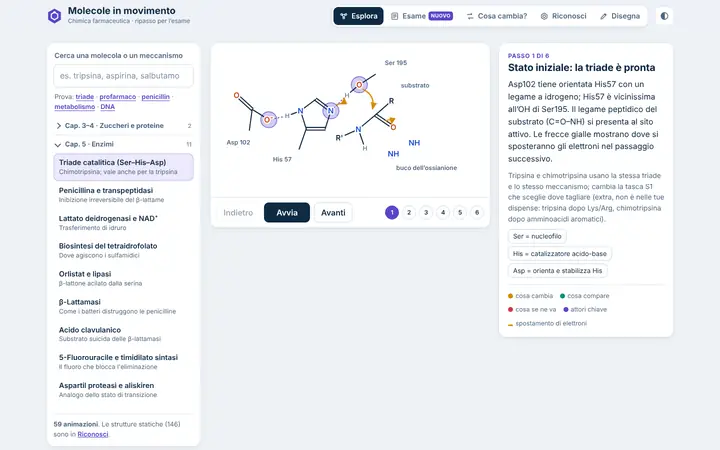
  7. Molecole in movimento

    A revision site for pharmaceutical chemistry, with molecules that move

    Running on the server, behind a passcode or loginJavaScript 59%, 1,306 lines
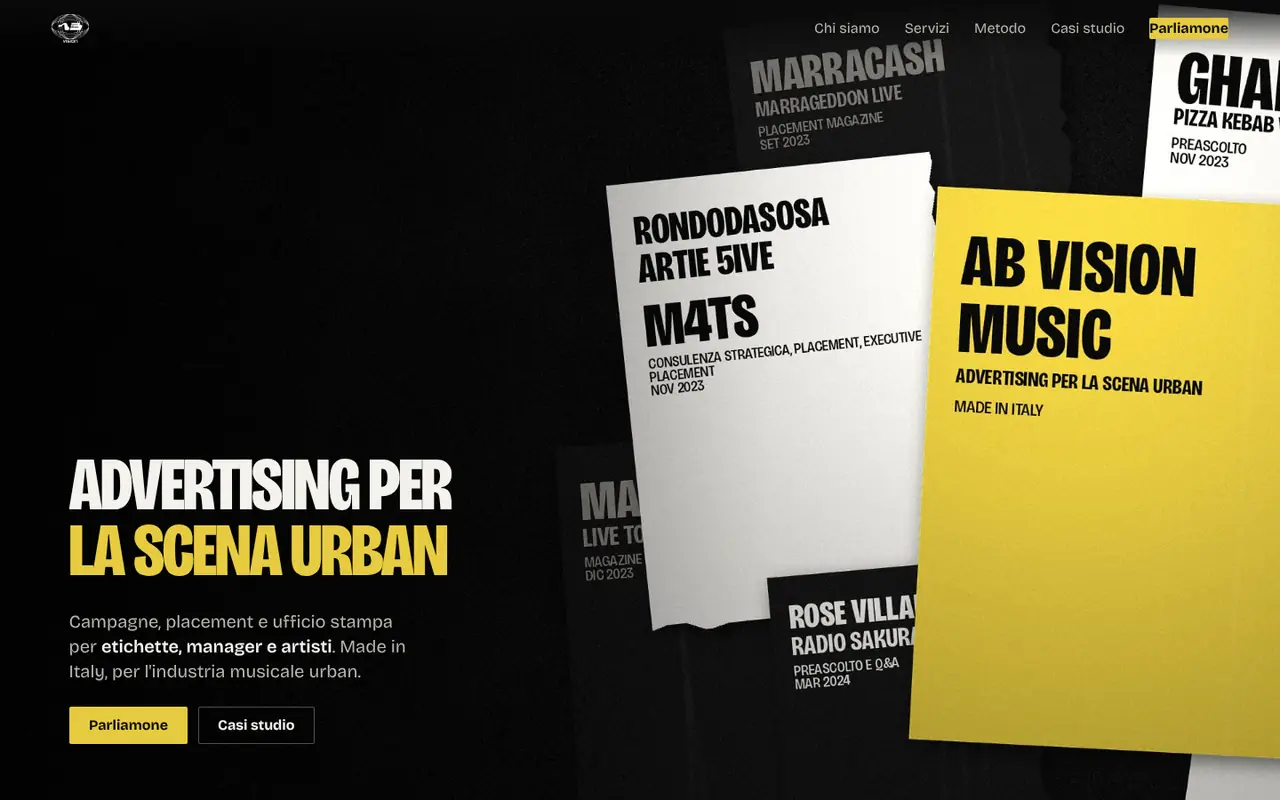
  8. AB Vision Music

    Landing page for a music-marketing agency I was a partner in

    Running on the server, open to visitHTML 100%, 558 lines
  9. A birthday site

    A private, animated gift site with a two-way daily mailbox

    Running on the server, behind a passcode or loginHTML 55%, 3,568 lines
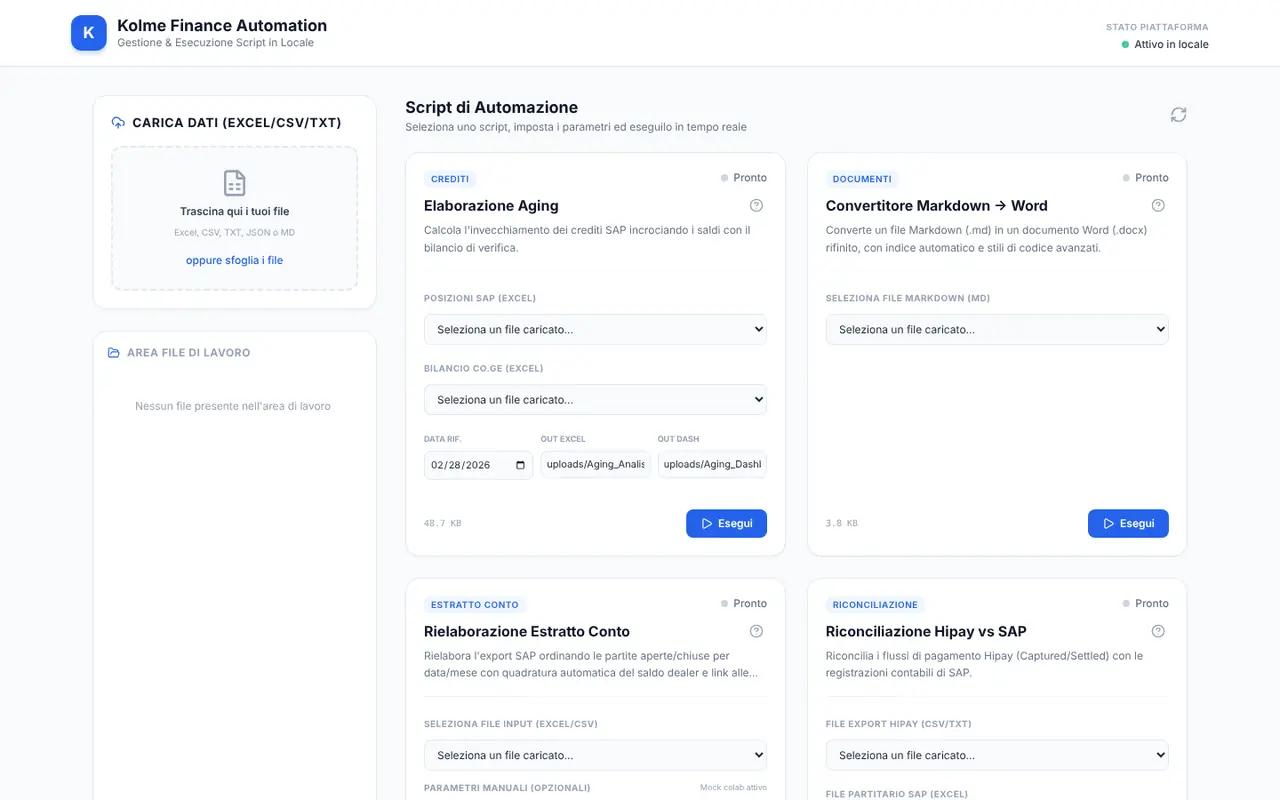
  10. Finance automation

    Eleven Python scripts that took about 65 hours a month of manual finance work off a team

    Runs on my PC when needed, code is publicPython 84%, 6,016 lines
  11. Investment tracker

    A P&L engine for a multi-broker portfolio, being rebuilt as a web app

    In progress, on my PC, code is publicTypeScript 81%, 8,057 lines

RossettiLab

The server everything else runs on, set up and run by me

VisitorsHTTPSCaddyTLS, routing, per-host metricsStatic sitesone folder eachn8n mainwebhooks, editorGrafanaMission ControlUmamivisit countsRedisjob queuePostgresn8n, warehouse, Umamin8n workers ×2run the executions
Request path. Every container has a CPU and memory cap, and nothing but Caddy listens on a public port.
node-exporterhost CPU, RAM, diskcAdvisorper-container useBlackbox11 site probesCaddy and n8nrequest and queue metricsPrometheus15 days keptGrafana9 rows, 48 panelsTelegram12 alert ruleshealthchecks.ioping every 5 min
Monitoring. If the server itself goes quiet, the missing ping to healthchecks.io raises the alarm.

One small VPS that I administer myself. Caddy terminates TLS and routes every domain; behind it run the static sites, n8n for automation, a Postgres database that doubles as a data warehouse, and the monitoring that tells me on Telegram when something breaks.

Big changes happen as written missions: a plan, a preflight, a dry run, then execution on the server by Claude Code, with a deploy report and a rollback for every phase. Mission 1 (26 September 2026) moved n8n to queue mode on Postgres with Redis and two workers. Mission 2 (26–27 September) added the warehouse, the monitoring stack, alerts and self-hosted analytics.

The warehouse collects what my automations produce: daily habit data from my routine tracker, portfolio snapshots and watchlists, and the Catalyst Core briefings, a daily market summary that n8n writes with Gemini. Grafana reads it through a read-only role.

Worth knowing

  • Alerts cover what actually hurts: a site down for two minutes, TLS expiring within 14 days, disk above 80%, a container near its memory cap, a failed n8n run, a warehouse feed gone stale, and Google Cloud spend forecast above €5 a month.
  • Metrics stay private. n8n's /metrics answers 404 from outside and Caddy exposes its own only on an internal port.
  • Least privilege in the database: the ingest role can insert and update but never delete; Grafana's role is read-only and sees seven columns of n8n's workflow table, nothing more.
  • Every project lives in its own folder with the same layout: site/ is what ships, ops/ holds runbooks, docs/ and anything starting with _ never leave my PC.

Balderdash

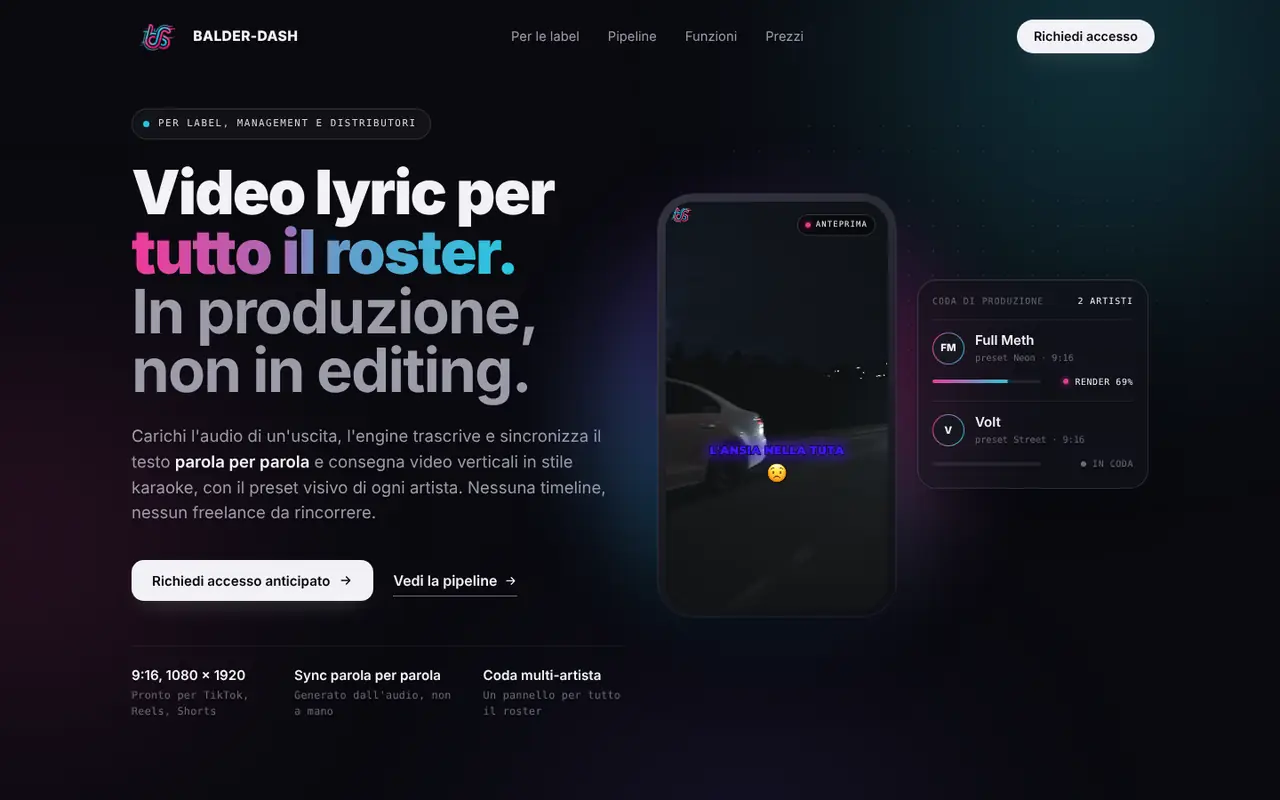
Lyric videos for a whole roster, made in production instead of in editing

balderdash.it
The balderdash.it landing page: lyric videos for the whole roster
Three frames of one render: word-synced lyrics over clips picked by mood.
Artistphone or laptopArtist appapp.balderdash.itSupabasejobs, audio, live statusn8nclaims the jobRender serverFlask + one FFmpeg passGroq Whispertranscriptiongpt-4o-minilyric clean-upClip poolGoogle Drive, by moodVertical video9:16 MP4PublisherTikTok queue
One video, from upload to publishing queue.
Pexelsstock footageScraperevery 6 h, mood scoreTriageapprove or rejectQA gateevery 15 minClip pool19 mood folders
Curation. Machines find and score clips; a person approves them; a QA gate checks them before they reach the pool.

An artist uploads a track. The engine transcribes it, syncs the lyrics word by word, picks stock clips that match the song's mood and renders vertical videos for TikTok, Reels and Shorts. Built with Alex Bonzano for the artists of his agency, AB Vision Music.

Four parts run on my server and one in the browser. The artist app (started on Lovable, now built and deployed from my own repo) writes a job to Supabase and calls an n8n webhook. n8n claims the job and hands it to a Flask render server that does subtitles, emoji and watermark in a single FFmpeg pass. A curation pipeline keeps the clip pool fresh, and a publisher queues finished videos for TikTok.

Engine v2 (10 October 2026) fused the render passes into one. Since then every render has gone through except the ones stopped on purpose by the daily cap; before it, one job in seven failed.

Worth knowing

  • Each part has its own deploy target. upload.sh sends the folder and shows the diff against live without changing anything; deploying a part backs it up first, and the publisher falls back to its previous image by itself if the new one is unhealthy.
  • The app's create flow is three steps: audio (title taken from the file name), text (with a transcribe button), style (remembered for the next video). The render estimate follows the server's real queue.
  • A weekly pool review in the triage app keeps the clip library from drifting: duplicates, short clips and moods that run thin.
  • The publisher is deployed and healthy; it is waiting on TikTok's app approval before it posts anything.

Job Radar

Watches the career pages I care about and pings me before a posting is a day old

Company listYAML, tiers A to C24 adapterspublic job boards onlyPostgrespostings, matchesBoard healthalerts once per breakageRules filterseniority, role, place, windowGemini scoreJSON schema, 0 to 100Telegraminstant or daily digest
A run, every two hours.

The system I use to find my next role. It polls the public job boards of the companies on my list, keeps only early-career roles that fit, scores each one against my profile with an LLM and sends it to Telegram.

One adapter per hiring platform (Greenhouse, Lever, Workday, SmartRecruiters, Ashby and nineteen more), each with a parser test on a saved page. A discover command works out which platform a company uses from its careers page, so adding a company is usually one line of YAML.

Rules do the cheap filtering first (seniority, function, location, recruiting window such as summer 2027 or graduate 2028), tuned for recall. Gemini then scores what is left against a JSON schema: an overall score, four sub-scores, a suggested route (apply cold, find a referral, skip) and a one-line reason.

Worth knowing

  • No scraping behind logins and no LinkedIn requests: only the endpoints the boards themselves expose.
  • Posting text goes to the model as data, never as instructions, so a job ad cannot steer the scoring.
  • A board that had postings and suddenly returns none is treated as broken, and nothing gets closed. It alerts once, then stays quiet until something changes.
  • The first fetch of a new company stores its matches silently and sends one summary. After that only new postings alert.

Nova Hub

Mock exams, theory and a library that files itself, for my master's study group

Nova Hub, group only
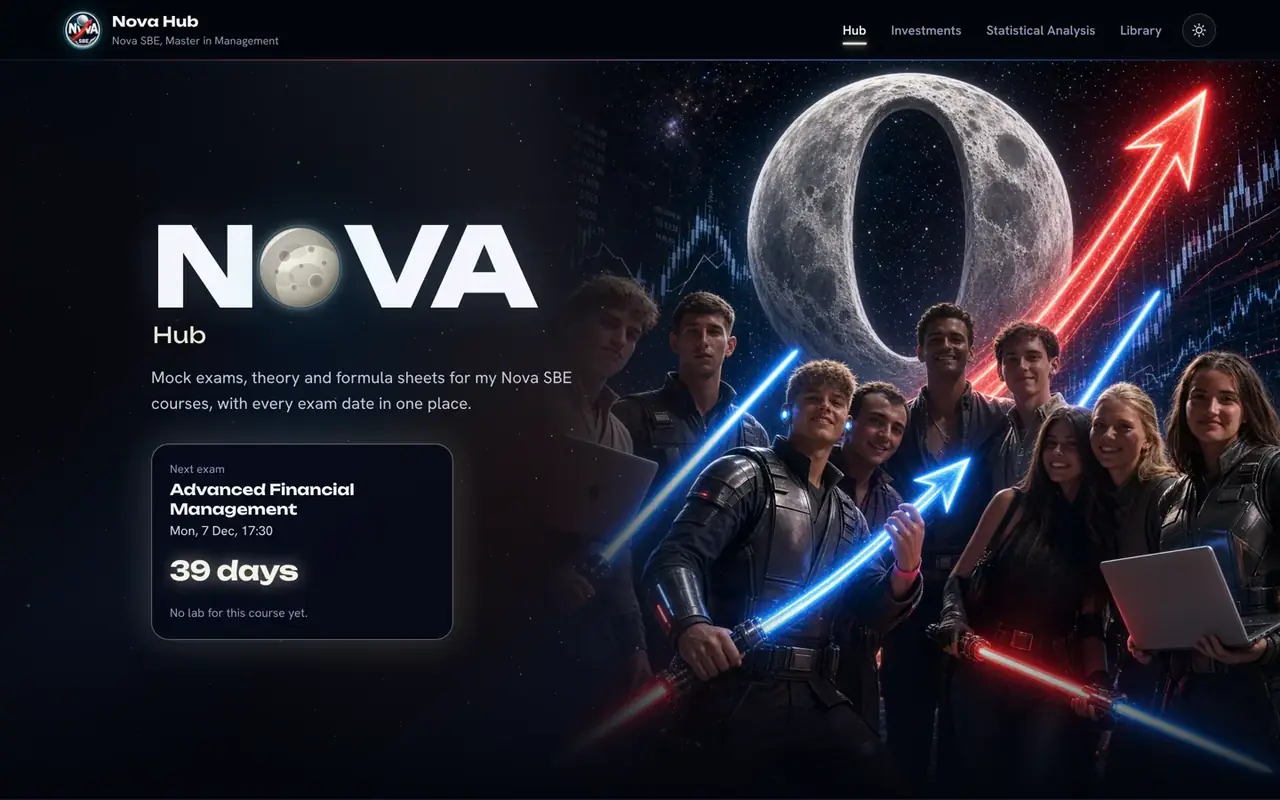
Nova Hub home: next exam countdown and course cards
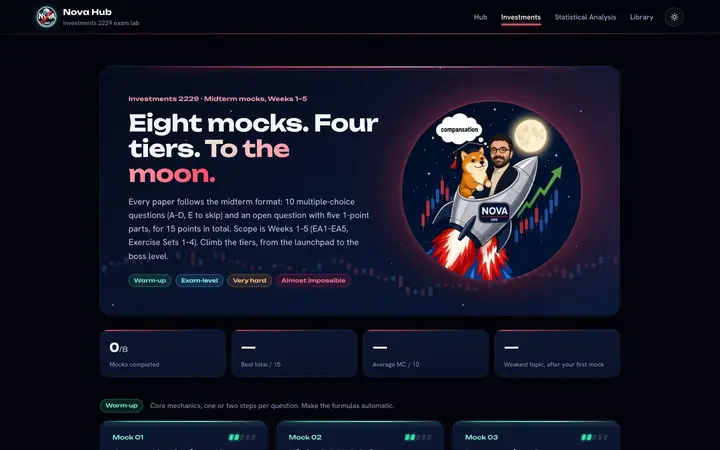
The Investments lab: eight mocks in four difficulty tiers
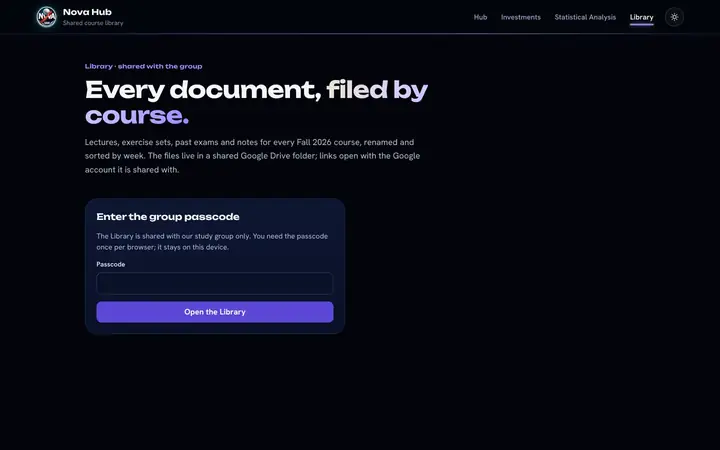
The Library gate: every document filed by course
Group memberuploads a fileNova Hubstatic single-page appLibrary APIn8n webhookCourse labsJSON content, no HTMLclassify.jscourse, week, typeGoogle Drivea folder per course
The Library: one set of filing rules, run in three places.

A study site for my group at Nova SBE. It started as a mock-exam lab for Investments and grew into a hub: an exam calendar with a countdown, course cards that show your progress, and a lab per course with theory, formula sheets, quizzes and a review of your mistakes.

Then there is the Library. Anyone in the group uploads a document; an n8n workflow reads it, decides its course, week and type with the same classify.js the browser and the tests use, and files it in Google Drive. A weekly job keeps the semester plan current, and the hub shows what is due this week.

It carries course material, so it is not public and search engines are told to stay out. Progress lives in each browser; there are no accounts.

Worth knowing

  • No framework and no build step, except a small generator for the stylesheet. Each lab is a JSON file of typed blocks that one engine renders.
  • Uploaded files go to Google Drive, not the VPS, so the server's disk stays free for video renders.
  • The deploy script lists exactly what ships; tooling, tests and the group passcode never leave my PC.

edoardorossetti.eu

The long version of my CV, with a receipt next to most claims

edoardorossetti.eu
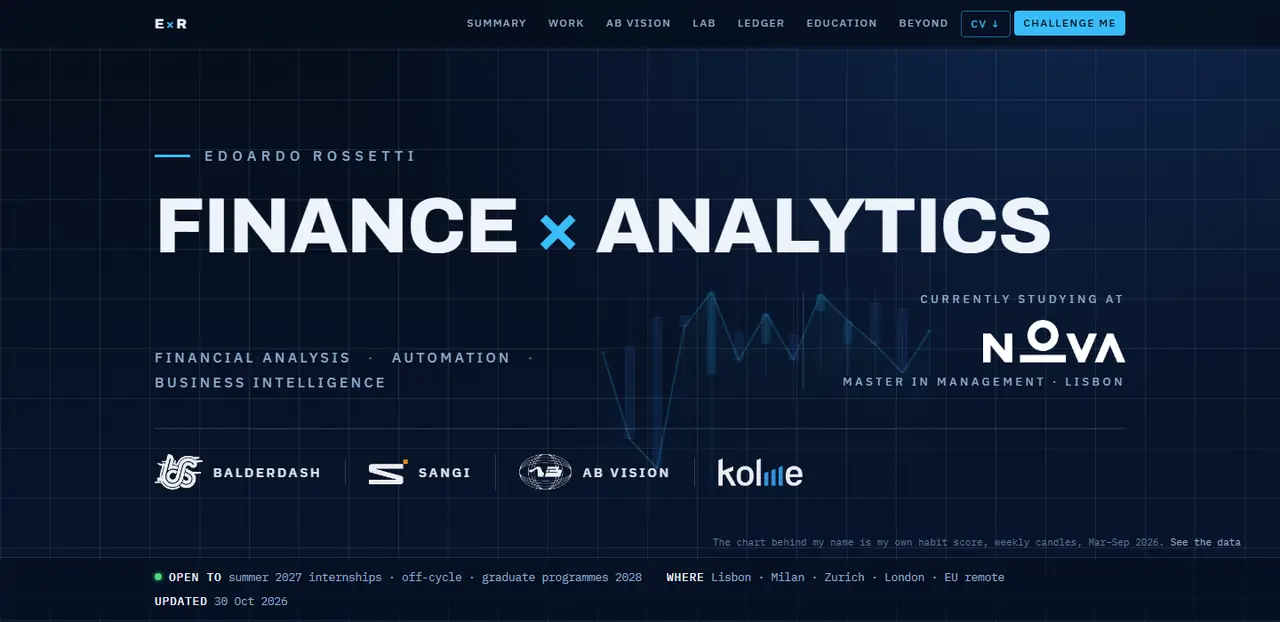
The hero of edoardorossetti.eu, with habit-data candles behind the name
Page partsHTML, images, CVsbuild.pySEO, JSON-LD, sitemapn8n, nightlyhabit dataindex.htmlone pageledger.jsonlive candlesCaddystatic filesVisitor
Build on the server, check, then swap in.

My personal site: education, experience and projects, written so a recruiter can see what sits behind a tailored CV. The candles behind my name in the hero are real: a public slice of my habit tracker, rewritten every night by an n8n job.

A Python script joins the page from parts, inlines the images and generates the SEO tags, structured data, favicons, social card and sitemap. The output is one HTML file and a handful of static files.

At the bottom there is a Challenge me form. It posts to an n8n webhook; challenges that hold up get logged on the page with credit.

Worth knowing

  • Deploys refuse to go live if the analytics snippet is missing, a {{placeholder}} survived the build, or someone edited a live file on the server since the last deploy.
  • Every deploy keeps a backup, and deploy.sh rollback restores it.
  • The files n8n writes (the ledger and the corrections log) are never overwritten by a deploy.

Dainis

Who is using what in a shared flat, and what makes the lights go out

Demo copy, placeholder names
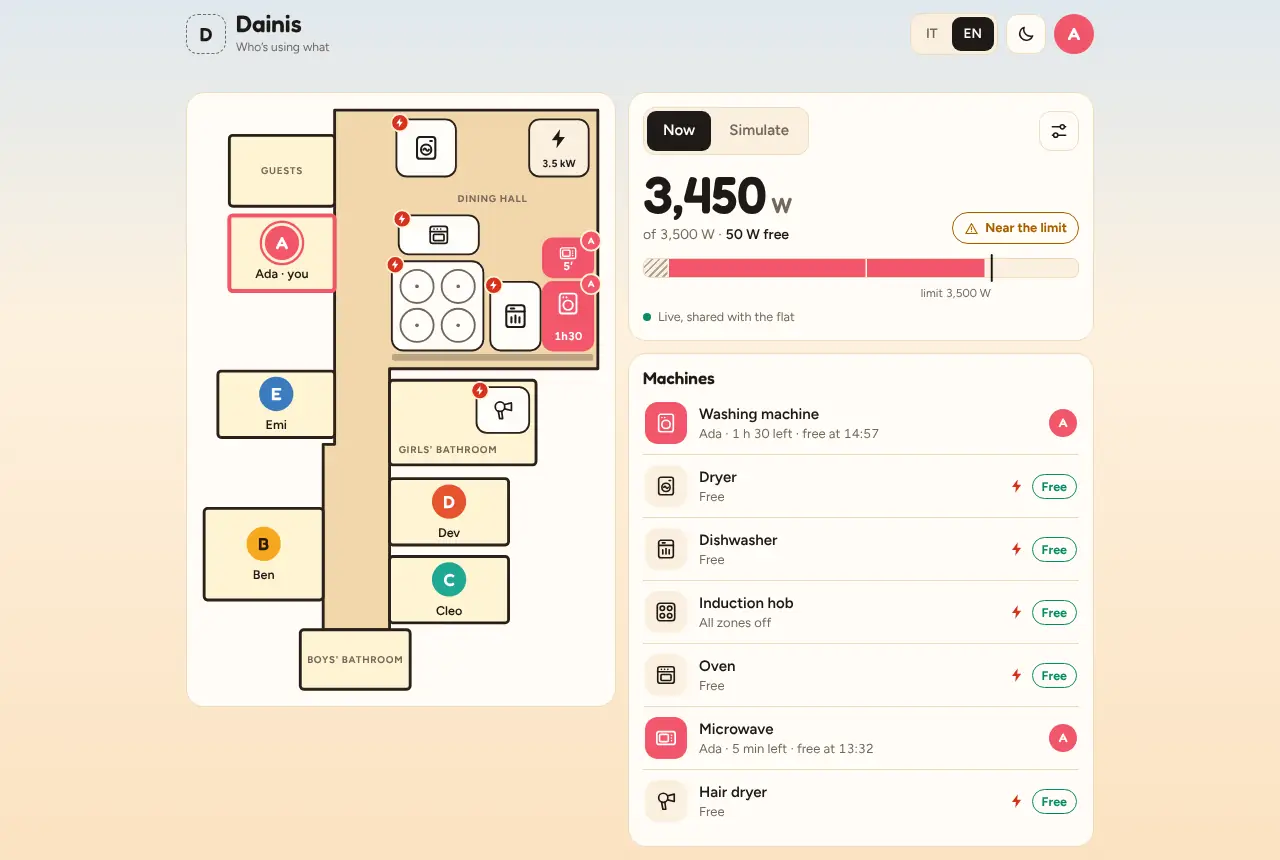
Dainis: the flat's floor plan, the watt meter near the limit and the machine list
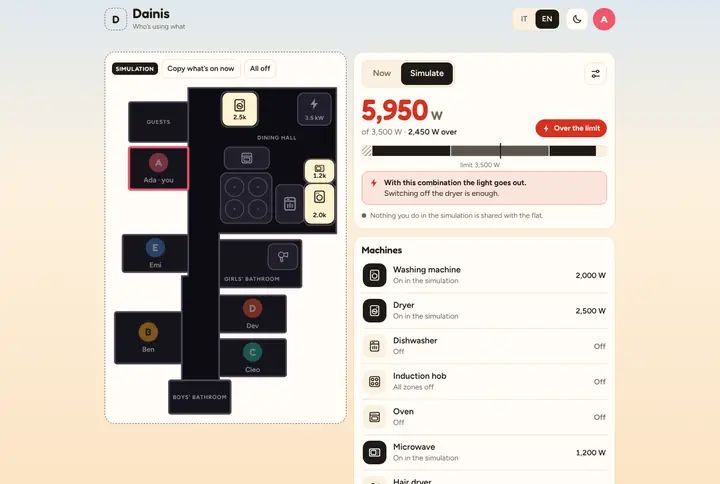
Simulate mode over the limit: the plan goes dark and the app names what to switch off

Screenshots from a local demo copy with placeholder names and no photos; the real one runs behind the flat code.

Flatmates' phonesinstallable appCaddyTLS, compressionserver.jsREST in, live events outstate.jsonDocker volume
A tap travels to the server and back out to every open phone.

A web app for a flat of five on a 3,500 W electricity limit. Run the dryer, the oven and a hair dryer together and the breaker trips. Dainis puts the flat's floor plan on everyone's phone: tap an appliance to start it under your name, see what is on and when it frees up, and get a warning before a start that would take the flat over.

When the flat is over the limit, the plan goes dark and the app names the one appliance that is enough to switch off. A simulate mode lets you try a combination on your own phone without touching the shared state.

The idea, the spec, the floor-plan concept, the deploy and the operations are mine; Claude wrote the code. It measures nothing: the watts are peak-draw estimates the flat corrects in settings.

Worth knowing

  • The server stores who started what and when, and nothing else. Each phone works out the load, the time left and what has finished from that data and the clock, correcting itself against the server's time.
  • Writes are debounced and atomic: written to a temp file, then renamed, so a crash never leaves half a state.
  • One shared code, no accounts. The cookie is an HMAC keyed by the code, so changing the code signs every device out.
  • Changes show on your phone at once; if the live stream drops, phones fall back to polling every 15 seconds.

Molecole in movimento

A revision site for pharmaceutical chemistry, with molecules that move

Molecole in movimento
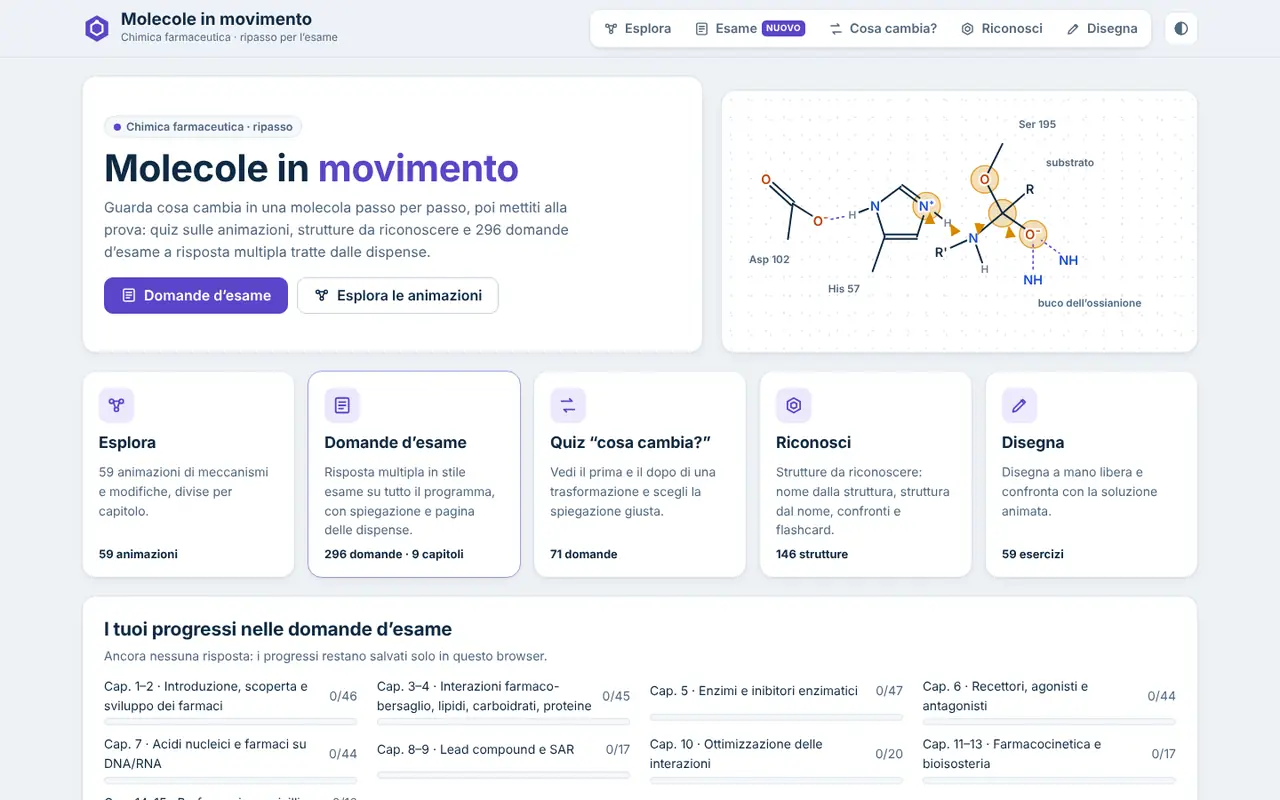
Molecole in movimento home: the five ways to study and progress by chapter
Explore: a mechanism animated step by step, with the explanation alongside
engine.jsdraws and animatesapp.js, mods.jsviews, router, quizzesgen.json, mcq.jsonanimations, questionsbuild.mjsjoins everythingindex.htmlthe only file onlineBrowserprogress saved locally
Many sources, one file online.

A study site, in Italian, for a pharmaceutical chemistry exam. A small drawing engine written for it draws molecules and animates reaction mechanisms and structural changes step by step.

Five ways to study: explore the animations by chapter; sit exam-style multiple choice in practice, timed or mistakes-only mode; guess what changed between two structures; recognise structures with flashcards; draw freely and compare against an animated solution.

The questions and animations were generated from the course handouts into two JSON files; the handouts themselves are never published.

Worth knowing

  • The generated file is never edited by hand; every change goes through src/ and the build.
  • Light and dark themes, and hash routes for each section so a link can open straight onto the exam or the drawing board.

AB Vision Music

Landing page for a music-marketing agency I was a partner in

abvision.it
abvision.it: advertising for the urban music scene
Labels and media the agency works with
Briefwritten firstindex.htmlplus fonts and imagesCaddyVisitorsUmamivisits in Grafana
Static, measured with my own analytics.

The agency's site: who they work with, the case studies and the platforms they place music on. I built it with the team from a written brief, then host and monitor it on the lab server.

My bigger contribution at AB Vision was the finance function: a cash calendar, cost to serve by client tier, a capacity model and a roster optimisation worth about 22% more monthly contribution with the same team hours. That case study lives on my site.

Worth knowing

  • Analytics are self-hosted Umami, so visitor data never leaves the server and shows up in the same Grafana as everything else.

A birthday site

A private, animated gift site with a two-way daily mailbox

Visitorwith the passwordCaddybasic auth, noindexStatic pageGSAP, five tabsMailbox APInotes and photosTelegram bothow I postServer storagephotos, notes
The mailbox: one container between the page and a Telegram bot.

A gift, so the content stays private; the engineering doesn't have to. It is a scroll-driven page animated with GSAP, behind a password and out of search engines.

Its mailbox makes it a place to come back to: every day I post a note through a Telegram bot, the reply comes back through the site, and both of us can add photos that appear in the gallery straight away. A small Python API in one container handles notes and uploads; everything is stored on the server.

Worth knowing

  • Deploys refuse if the page is truncated, a placeholder survived, or the page points at a photo or script that is not in the folder.
  • A yearly cron line unlocks one part of the site on the right date, so the surprise does not depend on me being online.

Finance automation

Eleven Python scripts that took about 65 hours a month of manual finance work off a team

127.0.0.1:5001
The local dashboard: each script as a card with its inputs and a Run button

The real dashboard, run locally with an empty work area. Its interface is in Italian, the language of the team that uses it.

SAP S/4HANAledgers, trial balanceSDIItalian e-invoicingPayment providertransactionsBank and factorassignment outcomesLocal dashboardFlask on 127.0.0.1One script per processreconcile, age, DSOReportExcel, CSV or HTMLBilling and ARTreasuryCredit and salesCFO and audit
From system exports to the team that needs the answer.

What I built during my time in Finance & Treasury Operations at Kolme, a telecom master dealer serving a network of retail dealers across Italy. Much of finance ran on manual exports out of SAP; I turned the recurring ones into scripts that colleagues run from a local web dashboard, without writing code.

Drop the exports in, pick a script, fill in its inputs, press Run. The output streams live to the page and the finished Excel, CSV or HTML report downloads by itself. The dashboard reads each script's docstring for its name, category and instructions, so a new script appears just by dropping it in the folder.

Published with Kolme's permission: code only, no ledgers, no exports, no customer data.

Worth knowing

  • Nothing leaves the PC: the dashboard listens on localhost only and files stay in its uploads folder.
  • The first scripts were written in Google Colab to get round corporate IT limits; a local stand-in for google.colab.files lets them run unchanged.
  • Covers SAP-to-SDI invoice reconciliation, payment-provider matching, receivables assignment files, failed-assignment dashboards, dealer statements and direct debits, ageing, and DSO and DPO from the trial balance.

Investment tracker

A P&L engine for a multi-broker portfolio, being rebuilt as a web app

Excel trackerone sheet per portfolioYahoo Financelive pricesBroker statementsRevolut, Crypto.comget-pricesCoinGecko, Yahoo, ECB FXP&L enginePythonWeb appReact + SupabaseStreamlit dashboardcompare two portfoliosLive dashboardrealised P&L split
Today two pipelines; the dashed line is where they will join.

Tracks a portfolio spread across brokers (stocks, ETFs, bonds, crypto) in one currency: positions, unrealised and realised P&L, sector allocation and returns over 1, 3 and 6 months, year to date and a year.

Two halves do the same job two ways. The Python engine works today on an Excel tracker, prices every position live from Yahoo Finance, converts between EUR, USD, CHF, GBP and JPY and puts a Streamlit dashboard on top. The web app reads Revolut and Crypto.com statements directly and prices them through a Supabase edge function.

The plan is one source of truth: the app's database replaces the spreadsheet and the engine reads from it.

Worth knowing

  • Statements must be read all at once: positions are rebuilt from the first transaction, so a single statement on its own gets quantities and average costs wrong. The upload takes several files and drops rows that appear twice.
  • A Crypto.com exchange is one row with two legs, and both get booked. USD rows convert to EUR at the ECB rate of their own date.
  • If a row's quantity times price disagrees with the sheet's own total, the engine derives the price from the total and warns, so one bad cell can't distort the portfolio.
  • No sign-in yet, so it runs on sample data only until per-user access is checked end to end.

Shipping log

2026, in the order things went live.

  1. First event site on the server, and the first lessons in running Caddy.
  2. AB Vision Music landing page goes live.
  3. Mission 1: n8n moves to queue mode on Postgres, with Redis and two workers.
  4. Mission 2: warehouse, Prometheus and Grafana, Telegram alerts, Umami.
  5. Job Radar starts its two-hour loop.
  6. First version of edoardorossetti.eu.
  7. The birthday site goes live.
  8. Balderdash engine v2: subtitles, emoji and watermark in one FFmpeg pass.
  9. The Investments mock-exam lab becomes Nova Hub, with a Library that files itself.
  10. Molecole in movimento, the pharmaceutical chemistry site.
  11. Balderdash app: eleven production deploys in two days.
  12. Every project gets its own folder layout and repository; four go public.
  13. Dainis, built and deployed in a day.
  14. This page.

What the server runs

Every container has a hard memory cap. The outline is the cap, the fill is what it used, measured on 27 September 2026 right after Mission 2. Containers added since (the Balderdash publisher, Job Radar, Dainis and the birthday site's mailbox) are not in this snapshot.

ContainerJobMemory cap, and useMiB used / cap
n8n mainautomation, webhooks
349 / 1024
Postgresn8n, warehouse, Umami
71 / 1024
n8n worker 1runs executions
288 / 768
n8n worker 2runs executions
302 / 768
Grafanadashboards, alerts
253 / 512
Umamianalytics
291 / 512
Prometheusmetrics, 15 days
93 / 512
cAdvisorcontainer metrics
36 / 256
Balderdash triageclip review app
65 / 256
Redisn8n queue
6 / 192
CaddyTLS and routing
28 / 128
node-exporterhost metrics
12 / 64
Blackboxsite probes
34 / 64
Render serverBalderdash video engine, on the host
– / 2560
In useCapRuns on the host, not in a container